LeadershipWatch
A Popular Source of Inspiration for Leaders all over the World

Leading Change: 3 Key Tips from Wi-Fi Pioneer Cees Links

 This post is part of our Expert Series in which Hanneke Siebelink shares valuable leadership lessons from a list of experts, researchers and role models she selected and talked to. Read all LeadershipWatch Series articles here.
Did you ever hear the story of how Cees (‘Case’) Links, whose boyish face lights up behind his glasses when he recounts it now, convinced Steve Jobs to embrace Wi-Fi, the wireless internet technology he co-invented? ‘The whole idea for Wi-Fi came about at a McDonald’s in the Netherlands where we managed to link our cordless phones together’, Links explains. He then proceeded to spend almost a decade pursuing the idea, which nobody thought particularly useful. Until finally, in 2000, the tipping point arrived. Steve Jobs called ‘unexpectedly’ and invited him to give a presentation in Silicon Valley. ‘With Jobs it was quite easy: you put your slides on the overhead projector and then he started to talk. From time to time he said: ‘Next slide.’ Until no slides were left. He said he rather liked it. From then on it was drinking from a firehose.’
Cees Links, father of five and now CEO of chip company GreenPeak Technologies (www.greenpeak.com), invented a groundbreaking technology, and managed to turn his vision into reality. And yet, not many people know him. Links, currently pioneering Smart Homes and the Internet of Things, clearly does not seek the spotlights. ‘I attach little importance to it’, he says when asked if he would like to be more famous. Reason enough, I thought, to look at how this 57-year old operates and leads. Which 3 key things can business leaders learn from Cees Links?
1. Look far into the future. Look further than the rest
When Links and his team thought up Wi-Fi and created the first wireless LANs (Local Area Networks), he asked his wife to sew a laptop in his jacket so he could ‘illustrate that, in the future, people would carry their computers everywhere they went. It is good to see that really happened.’
Now here’s a man who consistently thinks years (say 10) ahead, understands technological developments, and keeps his eyes on the horizon as he turns his strategy to action. An important skill in these times of relentless change. Links, whose current firm produces Zigbee chips (‘a kind of Wi-Fi but for Smart Homes’), on where we go from here:
‘I think a Smart Home is actually the first chapter of what we call The Internet of Things. Just like how WI-FI started with the consumer in Apple Airport and iBook and now you see it everywhere, I think that once the sensor and the technology concepts are well understood, it will become industry hardened. I envision this to go out into any industry – into building automation, into agriculture, into cattle management, into logistics, and even into retail. A Smart Home, even as big as it can be, it is just phase one of the Internet of Things, which will again completely change the way we communicate with each other, as well as with our environment.’
Learn from Cees Links and educate yourself on technological developments. Understand what they mean for your business, and keep your eyes on the horizon as you navigate.
2. Execute!
Links: ‘Having an idea is easy, execution isn’t. You know you need to cross the ocean, but you can never do it in one go. You’ll sail from island to island; sometimes you will get it wrong and will have to turn. Dreaming is not difficult, figuring out what the rights steps are to turn the dream into reality: that is difficult.’
Good ideas are useless if they are not turned into concrete results. Creating a good strategy roadmap – one that creates a kind of rhythm, like a drumbeat, in your company or organization – can help you and your team to focus and refocus in the execution phase. Read this strategy execution checklist to further stimulate your thinking.

Find more about our Leading Change and Strategy Execution Services.
3. Never Give Up
When Links invented Wi-Fi, nobody believed that it would be a working, reliable resource with any useful application. Until 2000 when Apple implemented this technology in their Airport and iBook products. Wi-Fi became a reality only after a decade’s worth of effort.
‘Success is not final, failure is not fatal; It is the courage to continue that counts,’ Winston Churchill once said. Cees Links chose as his most important motto: ‘Never give up, there is always another chance.’
So take these men’s advice to heart and cultivate a Link-like stubbornness: ‘If it turns out I took the wrong road, I just try again.’
Thoughts?
Sources: Elsevier Magazine (Reed Business Media), Interview by Wouter van Noort of 17 May 2014. / Wireless&RF Magazine, March 2014. / Twitter @CeesLinks.
Like this post? Share it with others! Join us and register at the top of this page to stay up to date with LeadershipWatch articles and news. Your personal information will be kept strictly confidential. Hanneke Siebelink is Research Partner and Writer at HRS Business Transformation Services, and author of several books. Her current research focuses on how leaders build successful organizations by increasing the quality and effectiveness of collaboration across divisions, companies and cultures. In the Expert Series she shares valuable leadership lessons from a list of experts and role models she selected and talked to. Find out more about Hanneke and HRS services. If you would like to invite us to your organization, contact us here.
Cross-Cultural Leadership: How to Stimulate Your Asian Team Members to Speak Up?

In today’s globalized economy, the odds that you will lead or work with global business teams (including westerners and Asians, for instance) are clearly on the rise. In such global teams, team effectiveness is not only impacted by personal (people’s characters and temperament) and organizational (level of team alignment from the start) elements. There are important cultural elements at play as well. Cultural elements that can, if not understood and properly addressed, quickly lead to frustration and ineffective teams.
Imagine the following situation.
You are an American manager leading a global HR team from your company headquarters: London. One of your team members is Chinese – let’s call her Wang Xiaomei. She is both competent and kind, and masters the English language well. You have noticed a recurring pattern, however. Ms. Wang does not easily express her own opinion. Whenever discussions in the team get heated (the other team members – Dutch, American, and German – love heated discussions!), Wang Xiaomei literally draws back. Even when she has her own opinion. Even if she silently disagrees with what her colleagues are proposing. As a result, the problem surfaces too late. The other team members are getting increasingly frustrated about this.Do you recognize this?
Situations like these regularly happen, in my experience. Not only when people born and raised in Europe or America negotiate and work with Chinese people. I have seen the same issue pop up in business teams where west meets east (Japan, Korea, India) in general, and hamper team effectiveness.
Why does Wang Xiaomei not speak up? Is she just shy or could there be another explanation?
Directness of speech, or the degree to which people feel comfortable communicating in a direct and no-nonsense way, differs across cultures.

Cultures like the Chinese, Indian or Japanese are often referred to as high-context cultures: communication in those cultures tends to be indirect, nuanced, and layered, with listeners depending on a detailed understanding of subtle verbal and non-verbal cues within the given context to read between the lines.
Cultures like the American, German or Dutch, on the other hand, are generally perceived as low-context cultures: communication tends to be direct, explicit, and precise, and messages are generally taken at face value.
(The terms ‘high-context’ and ‘low-context’ were originally coined by the American anthropologist Edward Hall, who lived among Navajo and Hopi native Americans for many years and observed that human speech varies depending on whether there is a ‘high’ or ‘low’ level of assumed shared cultural context.)
Wang Xiaomei does not easily speak her mind, because to her it feels more awkward than to the shyest of Americans or Dutchmen. In addition, to Wang Xiaomei, speaking up in team meetings involves the risk of losing face.
In her culture, to admit you cannot do something is a loss of face. To say ‘Yes, I agree,’ and then have to change your position later is a loss of face. Losing your temper in public? A loss of face. Seasoned China experts like Samuel Y. Kupper maintain that westerners, no matter how well versed in the Chinese language and culture, can never truly understand the Asian concept of losing, and giving, face. ‘At best, we can be sensitive to the issue, be aware of it, and try to avoid causing the Chinese counterpart to suffer a loss of face’ (find here some useful tips on how to avoid making people lose face).
How can you prevent this type of culturally related communication issues in your global business team?
How can you, in an effort to improve your team’s effectiveness, encourage team members like Wang Xiaomei to speak her mind when needed?
 How to lead Cross-Cultural Teams? Discover our Cross-Cultural Leadership Services here.
These 3 things work well in my experience:
1. Use indirect language when inviting him or her to speak
Use language giving the other person ‘space’ and offering him/her the possibility to gradually move closer to the core of the issue.
For instance:
- ‘How are these kind of problems perceived in your country?’
- ‘Do you have an example you would like to share?’
Instead of:
- ‘What do you think we should do about this problem?’
2. Listen to what is meant instead of what is said
Ask clarifying questions, even if you think you know what the other is saying. Check carefully, and give the other the feeling you value his or her opinion and contribution to the discussion.
For instance:
- ‘What of what you just said would be the most important for us?’
- ‘Can you explain why you consider this to be important?’
Not:
- ‘So your opinion is …?’
- OK, I got it, you want us to do …?’
3. Ask for advice and invite the other to share experience
Asking for an opinion or direct solution can be confronting. Asking for advice is often a gentler way to invite the other to share ideas and experiences, and by doing that creating a better understanding of how he or she feels about the problem.
For instance:
- ‘What advice would you give to a team that is dealing with this challenge?’
- ‘What solutions have you seen working in the past?’
- ‘What do you think would be wise for us to do?’
Which approach has worked for you? Share your own best tips below!
Written by Aad Boot and Hanneke Siebelink
Like this post? Share it with others! Join us and register at the top of this page to stay up to date with LeadershipWatch articles and news. Your personal information will be kept strictly confidential. Photo:ValeryKensky/Flickr (Creative Commons) Aad is a global business advisor, change leader, executive team facilitator, leadership coach, and frequently asked keynote speaker. He is founder and managing partner at HRS Business Transformation Services where he works with senior executives and leadership teams globally in three key domains: ‘leading complex change’, ‘cross-cultural leadership’, and ‘post-merger integration’. Find out more about Aad and our services. If you would like to invite Aad to your organization contact us.
A Powerful Story about Team Diversity: The Philips Founding Fathers

This post is part of our Expert Series in which Hanneke Siebelink shares valuable leadership lessons from a list of experts, researchers and role models she selected and interviewed. Read all LeadershipWatch Series articles here.
In the winter of 1894, the young engineer and entrepreneur Gerard Philips could no longer deny the fact that he was worried. A few years back, he had – aided by his father Frederik – founded a company producing light bulbs. He was convinced that electrical lighting would soon conquer the world: his travels to Germany and the UK (Glasgow), where electric lamps already brightened up some streets, factories and theaters, had shown him that. So he had bought an empty factory in Eindhoven, a small village in the south of The Netherlands, for a price he could afford (12000 guilders). His 28 employees worked day and night for reasonable wages, and the quality of the lamps they produced was outstanding – thanks to the countless hours of innovative research and experiments he personally put in.

Gerard Philips (source: Philips Museum, Eindhoven)
So why was it that his company, after a flying start, was on the verge of bankruptcy? The thought that he could actually fail made Gerard’s stomach twist and turn. ‘For a while I was so worried I could not sleep,’ he recounted later.
Enters Gerard’s younger brother Anton, who didn’t think much of Eindhoven (‘a group of houses in a desolate and misty place’) but decided to team up with his brother anyway.
No two men could have been more different. Gerard, whose moustache covered half his face, was not a man of many words. He was a strategist with a good sense of where he thought the company should go, but preferred the technical environment and silence of his research lab over noisy (and in his view often meaningless) conversations.
Anton, always with that twinkle in his eyes, had never been the genius his brother was. But he had a nose for the commercial side of things, and did he have a talent for understanding people! ‘He was very energetic, loved meeting new people and took decisions swiftly’, his grandson remembers. ‘When Philips was still a tiny company, he traveled to America to buy a state of the art machine from General Electric. He somehow managed to befriend the senior leadership. The machine ended up going to Philips – not to a much larger company, as GE had originally planned.’

Anton Philips (source: Philips Museum, Eindhoven)
The Gerard-Anton team proved to be a powerful combination. With Anton taking sales under his wings (he traveled to the farthest places to talk and listen to sales agents and dealers in person – many sons of which remember their father’s stories about ‘Mr. Anton’ to this day), Gerard could focus on what he knew he did best: the R&D side and the production process. Anton, on the other hand, would never have sold as many light bulbs without the continuous quality improvements his brother guaranteed.
The synergy and healthy competition between the Philips brothers served many people well. The company they built together lies at the basis of the multinational Philips N.V., which in turn lies at the basis of the city of Eindhoven, currently one of the most inventive cities in the world. Entrepreneurs speak highly of the ‘extremely collaborative ecosystem’ they find on Eindhoven’s High Tech Campus (Read a nice Forbes article about it here: Why Europe’s hottest Med Tech entrepreneurs are pitching up in the Netherlands). The Philips founding fathers, had they been alive today, would probably have been proud.
What can today’s business leaders learn from this true story? Here are some questions to reflect on:
1) Could it be that the real driver of progress and innovation is collaboration between people, and not the individual – no matter how bright he/she is?
Author Joshua Wolf Schenk, for instance, is convinced that the lone genius is a myth. Even Einstein, he argues in his intriguing book ‘Powers of Two’, would not have come up with his relativity theory without his collaboration and frequent conversations with engineer Michele Besso.
If true, to what extent do we deliberately choose teamwork to create the innovation and progress that will drive our company’s success?
2) A variety of backgrounds (education; character; culture, …) can make a company more adaptable to its ever changing environment. Healthy debates can lead to better decisions. We all know many reasons why diversity in teams and in the boardroom is important. But do we really choose diversity over like-mindedness when confronted with a business challenge?
To what extent do we actively seek diversity, even when we feel we are dealing with great differences that seem incompatible, like opposite poles? Do we make one another’s best qualities explicit, and combine them to achieve remarkable results? Just like the Philips founding fathers did in Eindhoven?
We look forward to hearing your experiences and thoughts!
Sources: ‘Het Wonder van Eindhoven’ (Arno Kantelberg); ‘Anton Philips’ (Marcel Metze); Philips Museum, Eindhoven.
Like this post? Share it with others! Join us and register at the top of this page to stay up to date with LeadershipWatch articles and news. Your personal information will be kept strictly confidential. Photo: James Bowe/Flickr (Creative Commons)Hanneke Siebelink is Research Partner and Writer at HRS Business Transformation Services, and author of several books. Her current research focuses on how leaders build successful organizations by increasing the quality and effectiveness of collaboration across divisions, companies and cultures. In the LeadershipWatch Series she shares valuable leadership lessons from a list of experts and role models she selected and interviewed. Find out more about Hanneke and HRS services. If you would like to invite us to your organization, contact us here.
Strategy Execution: A Short Checklist that Helps

Strategy execution is clearly a key topic on the agenda of Boards and Executive Committees. In the work we do for our clients the question “how can we become more effective in turning our strategy into concrete results?” is very often one of the main questions. (In a previous article I mentioned the main reasons for this increased need for effective strategy execution). The increased focus by senior leadership on strategy execution is a good thing. If you’re not fast and effective enough at it, you quickly can get into trouble.
“Five percent of the challenge is the strategy. Ninety-five percent is the execution. At the end of the day, the most disciplined organization, the organization which gives a lot of importance to processes, ends up prevailing.” (Carlos Ghosn)
When we talk about improving strategy execution we actually talk about increasing our ability to deal with continuous change, and doing this successfully as an organization.
It is simple: the better the organization becomes at achieving strategic priorities and results, the more confidence and trust will grow within the organization. And the outside world (customers, suppliers, partners, the public) will recognize this.
Is there a standard solution that will make an organization a champion in strategy execution?
Unfortunately not. Defining the right approach depends on the business sector, corporate culture, business model, market developments, etc. But the following list of questions might be useful. Leaders can use these questions as a checklist to analyse for themselves or together with their team how the organization is doing, and which points would need further attention.
- Do we have enough clarity about the vision, the strategic priorities, and the results the company wants to accomplish? Is it clear enough WHY these are important?
- Does this clarity exist throughout the organization or only in specific parts of the organization (for instance mainly at the top)?
- Are people stimulated early in the decision-making process to contribute their experiences/ideas? Are they invited to think along in creating the vision and strategy? Are they co-owners?
- How does the top of the organization show its commitment to the vision, priorities and results? How well do people feel that it is top-of-mind for the executive team?
- Do we have a longer-term horizon or mainly a short-term focus? Why?
- Do we optimize cross-border collaboration? Do we know the existing collaboration barriers? Do we have a plan on how to eliminate these?
- Do we understand potential cross-cultural differences that might hinder teams to collaborate effectively? If not, why? How do we deal with these differences effectively?
- How do we monitor progress and success? How do we report and communicate results? Do we have a clear road map?
- How do we maintain focus throughout the organization? How do we detect when we slide out of focus? How do we correct?
- How do we communicate and share successes with each other? How do we create collective learning out of our successes and our failures? How do we share and transfer knowledge within the organization? What can we do to influence this positively?
What would you add to this list? I look forward to reading your reactions!
Like this post? Share it with others! Join us and register at the top of this page to stay up to date with LeadershipWatch articles and news. Your personal information will be kept strictly confidential. Photo: Shutterstock.com Aad is a global business advisor, change leader, executive team facilitator, leadership coach, and frequently asked keynote speaker. He is founder and managing partner at HRS Business Transformation Services where he works with senior executives and leadership teams globally in three key domains: ‘leading complex change’, ‘cross-cultural leadership’, and ‘post-merger integration’. Find out more about Aad and our services. If you would like to invite Aad to your organization contact us.
Why Collaboration Is a Top Concern for Every Leader

Senior leaders regularly share with me their concerns about the level of collaboration in the company. They often mention the lack of cross-organizational collaboration they experience, and how this is hindering the company to execute its strategy successfully. They see how the company is not fast or flexible enough, how people and units do not align and combine their efforts quickly enough, how achieving results takes too much time, or how objectives are not met at all. They see it as an important issue and ask me for advice on how to improve the quality of the collaboration (mind you, the quantity is not always the problem).
I often witness the following reflexes in the behavior of executives when they are confronted with collaboration issues: intervene in the structure to force collaboration / change the composition of teams / have HR organize a collaboration skills training for employees. And yet, the results of these interventions are limited or at best only a part of the solution. Why?
Apparently some leaders do not see creating effective collaboration as an essential part of their own role. They believe strategy development is their role, not the execution process. ‘That is for line-managers and their teams, I do not have time for that; it is their job.’ When collaboration issues occur they are delegated to lower management or the HR department. This may have worked in the past, but in today’s business reality this is not working! What has changed?
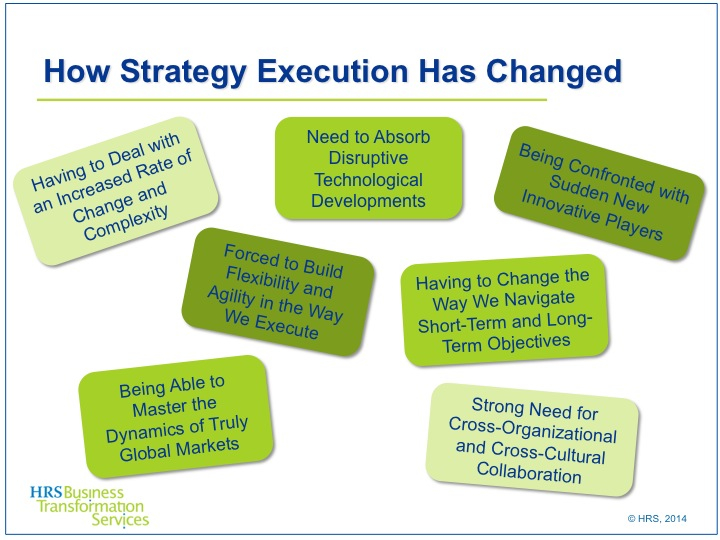
Strategy execution today requires organizations to develop more flexibility, adaptability, and continuous navigation. People in organizations struggle with this!
Successful strategy execution requires leaders to develop new ways of collaboration. New ways in order to connect and align people, teams, units, regions across organizational borders. Connecting people and teams in such a way that information, knowledge, expertise, ideas and solutions get exchanged and aligned faster and more flexible throughout the organization. New ways to really create collective focus on priorities, resources, and actions. Ways of collaboration that stimulate people to deal differently with accountability. Ways of collaboration that help people to develop and increase their adaptability. Collaboration that is disciplined enough and leads to concrete results.
Successful strategy execution requires leaders to develop new ways of collaboration.
Today’s leaders are facing two key challenges:
- How can I guide the organization successfully in translating our strategy into effective execution? (read this article for some tips);
- How can I stimulate and support people at all levels of the organization to create the right way of collaboration that supports our strategy? (read this article for some guidelines).
Two reasons why collaboration should be a top concern for every leader.
What are your thoughts? What should leaders do to create effective collaboration? What do you see working well?
Like this post? Share it with others! Join us and register at the top of this page to stay up to date with LeadershipWatch articles and news. Your personal information will be kept strictly confidential.Photo: Shutterstock
Aad is a global business advisor, change leader, executive team facilitator, leadership coach, and frequently asked keynote speaker. He is founder and managing partner at HRS Business Transformation Services where he works with senior executives and leadership teams globally in three key domains: ‘leading complex change’, ‘cross-cultural leadership’, and ‘post-merger integration’. Find more about Aad and our services. If you would like to invite Aad to your organization contact us.
Cross-Cultural Leadership: The One Secret Success Ingredient

Do business leaders and HR departments pay sufficient attention to equipping people preparing for international assignments, as well as managers leading cross-cultural teams, with sound cross-cultural leadership skills? Research conducted at Dutch Neyenrode Business University suggests they don’t. And that’s a pity, the same research points out: costs related to failed international assignments are sky high, while the one secret ingredient that turns the odds in favor of success – developing the right cross-cultural mindset – is something that can be trained and coached.
In our fast-paced globalized economy, international assignments are on the rise. According to KPMG’s yearly survey of global assignment practices, companies generally make it easier for employees and their families to work and live abroad, both for short- and longer-term assignments. They also invest significant amounts of time and money to make expatriate assignment a success.
Unfortunately, says Dutch economist Matthias Spaink who recently presented the results of his PhD study on “Characteristics of Intercultural Competence among International Business Assignees”, many such international assignments fail. ‘Failure rates of expatriate assignments have been estimated anywhere in between 16 and 50 percent, with financial consequences ranging from $200,000 to $1.2 million’, according to Spaink. Failed cross-cultural assignments can be very painful for the expat and his or her family, returning home without a sense of accomplishment. And they are always painful for the company concerned, both in terms of direct costs and in terms of reputational damage.
‘So what went wrong?,’ the question then becomes. Neyenrode’s Spaink, himself a seasoned businessman, decided to dig into the subject. ‘I wanted to provide more insight in key factors determining intercultural competence among Western international assignees, so that Western multinational companies can improve their decision making on both selection and training/development of international assignees, ultimately leading to reduced failure costs related with failed international assignments.’
What does his research (click here for background information) tell us? What determines a person’s effectiveness in cross-cultural business situations?
People will be most successful in cross-cultural business situations, the study finds, if they possess, or develop, the following leadership characteristics:
- A curious mind;
- Explorer’s mentality;
- Emotional intelligence;
- The genuine will to understand what lies behind the habits, traditions and patterns of interaction that are different from one’s own (‘the curiosity and will to understand what’s different should be positive, open, and nonjudgmental,’ Spaink adds);
- A sense of humor (humor, even mixed with self-mockery, can take away a lot of tension);
- Strong self-identity (self-reflection and self-knowledge, combined with awareness of your own cultural identity and the way you perceive other cultures and differences).
The key ingredient determining success in unfamiliar cultural settings is: MINDSET.
Sounds logical, right? And yet, companies pay very little attention to this aspect according to Spaink (which is in line with what I witness when supporting multinational companies and their leaders in improving cross-cultural effectiveness).
Not in the recruitment & selection process, where the focus is mainly on technical and functional competences.
Not in training & development processes. These traditionally focus on knowledge and skills as key elements of expat trainings. In fact, the development of attitudes is equally, if not more, important. Most importantly attitudes like “being open for the unexpected”, “strong self identity” and “seeking for diversity”.
In other words, preparing people by simply training the do’s and don’ts of cultural etiquette is not enough.

Cross-Cultural Booster Programs (find out more)
I see a huge potential for companies to increase their success in managing international expansions and assignments, and the cross-cultural challenges these bring. It is essential to pay more attention to stimulating people to develop an effective cross-cultural mindset. By incorporating this in the learning & development processes of the organization, by making it an important aspect of leadership development and team development programs. Not by focusing only on training, but by also putting in place on the job coaching and mentoring programs. And I mean coaching and mentoring in which the leaders of the organization play a central role.
Leaders who are able to support and coach their people and teams to deal effectively with cross-cultural challenges will boost the company’s success (read more here).
What are your thoughts? Do companies pay enough attention to developing cross-cultural competence? What is your experience?
Like this post? Share it with others! Join us and register at the top of this page to stay up to date with LeadershipWatch articles and news. Your personal information will be kept strictly confidential.Photo: Hey Paul/Flickr (Creative Commons)
___________________
Aad is a global business advisor, change leader, executive team facilitator, leadership coach, and frequently asked keynote speaker. He is founder and managing partner at HRS Business Transformation Services where he works with senior executives and leadership teams globally in three key domains: ‘leading complex change’, ‘cross-cultural leadership’, and ‘post-merger integration’. Find out more about Aad and HRS’ services. If you would like to invite Aad to your organization contact us.
Strategy Execution: Why It Often Fails

A senior executive recently shared with me: “I have been explaining our new strategy for months, and last week in a leadership meeting I got astonishing feedback. The main message was ‘we have no clue where we’re going with our strategy’. How is this possible?! Defining a good strategy, and executing this strategy successfully are two separate things. Why does strategy execution often fail?
The CEO of Philips, Frans van Houten, recently remarked: “We often have good ideas, but we have to execute these well, otherwise they are useless.”
In the words of former CEO of Royal Dutch Shell, Jeroen van der Veer: “The biggest danger for an organization is that you go too slow. You need to make clear choices and swiftly execute these.”
Defining a good strategy, and executing it successfully are two separate things.
In my work I see a lot of executives struggle with the switch between strategy development and strategy execution. Executive teams put a lot of time and effort in defining the new strategy, they put it on paper, communicate it, and expect the organization to take over and roll it out as was communicated. But that hardly ever happens …
Successful strategy execution (especially in today’s business environment with a high rate of change and complexity) requires leaders to be aware of three essential pitfalls. Pitfalls that occur regularly, and that you maybe also witness in your organization.
1) The communication about our strategy is not creating focus
Communicating your strategy in a way that does not lead to a collective focus is very likely creating confusion, scattered actions, a lack of motivation, or even chaos. But still some leaders believe that a road show with a deck of slides filled with data and charts will do the trick.
Successful leaders approach it differently and pay special attention to creating a strategic road map, which communicates a clear message to everybody. And they engage their team or a group of key stakeholders in creating this road map; they make it ‘our’ road map. Their strategy road map describes:
- where do we want to go (our vision)
- why do we want this change (the gap with the current reality)
- which choices do we make to get there (our strategic priorities)
- what do we want to get out of it (our desired results)
- how do we want to achieve these priorities (the steps, timing and resources).
A powerful strategy road map is channeling the energy and actions of the people involved. It creates focus and drive instead of a feeling of ‘more workload’. Make no mistake, having a collective focus has a direct impact on motivation and performance (read more about this in this New York Times article), and therefore on successful strategy execution. A good strategy road map stimulates this.
.

For more on our strategy execution services, click here.
.
2) There is a lack of ‘disciplined execution’
Intermediate developments and issues that absorb people’s attention easily sidetrack strategy execution. Leaders are sometimes not aware of the negative consequences this can have on the longer-term success of their company. They sometimes even trigger this sidetracking by jumping on operational issues, which not necessarily have strategic relevance. They sometimes allow people to postpone strategy execution because of these operational issues. By doing this they create a feeling among employees that strategy execution is something that comes on top of their daily work; something that is actually less important.
Successful leaders understand the importance of creating a culture of disciplined execution. Jim Collins and Morten T. Hansen, the authors of ‘Great by Choice’, describe what this means in their article ‘How to Manage Through Chaos’ with the following nice example:
Imagine you’re standing with your feet in the Pacific Ocean in San Diego, looking inland. You’re about to embark on a 3,000-mile walk, from San Diego to the tip of Maine. On the first day you march 20 miles, making it out of town. On the second day you march 20 miles. And again, on the third day you march 20 miles, heading into the heat of the desert. It’s hot, more than 100˚F, and you want to rest in the cool of your tent. But you don’t. You get up and you march 20 miles. You keep the pace, 20 miles a day. Then the weather cools, and you’re in comfortable conditions with the wind at your back, and you could go much farther. But you hold back, modulating your effort. You stick with your 20 miles.
Then you reach the Colorado high mountains and get hit by snow, wind, and temperatures below zero — and all you want to do is stay in your tent. But you get up. You get dressed. You march your 20 miles. You keep up the effort — 20 miles, 20 miles, 20 miles — then you cross into the plains, and it’s glorious springtime, and you can go 40 or 50 miles in a day. But you don’t. You sustain your pace, marching 20 miles. And eventually, you get to Maine.
Now, imagine another person who starts out with you on the same day in San Diego. He gets all excited by the journey and logs 40 miles the first day. Exhausted from his first gigantic day, he wakes up to 100˚ temperatures. He decides to hang out until the weather cools, thinking, “I’ll make it up when conditions improve.” He maintains this pattern — big days with good conditions, whining and waiting in his tent on bad days — as he moves across the western United States. Just before the Colorado high mountains, he gets a spate of great weather and he goes all out, logging 40- to 50-mile days to make up lost ground. But then he hits a huge winter storm when utterly exhausted. It nearly kills him and he hunkers down in his tent, waiting for spring. When spring finally comes, he emerges, weakened, and stumbles off toward Maine. By the time he enters Kansas City, you, with your relentless 20-mile march, have already reached the tip of Maine. You win, by a huge margin. (read full article here)
Successful companies are recognized for being excellent in defining and achieving their strategy, but this is always related to having a strong culture of disciplined road map execution.
3) Our strategy road map is a static document (that everybody has already forgotten)
When I am asked by leadership teams to advise and support them with their strategy execution one of the questions I always ask is: ‘In what sense has your strategy road map changed over the past year’? Quite often the answer is ‘not much really’, or ‘oh yes, maybe we should revisit our road map once again’.
A successful strategy road map is not a static document. It is actually never complete, but always evolving. Your strategy road map should tell a story that people listen to and are eager to follow. It should be checked, discussed, updated, and communicated on a regular basis. The aim is to create a kind of rhythm, like a drumbeat, in the organization. Everybody knows it and it is simple for everybody to follow. Separate people can be the ‘owner’ of the strategic priorities in the road map. This means they update their part of the road map on a regular basis, communicate it, and gather feedback from colleagues. Business environments change, so do our strategic priorities, and so does our road map. If it never changes (or worse, nobody can remember it) something might be wrong.
Let me know: how do you stimulate successful execution? How do you engage your team in this process and create disciplined execution? Share your comments below!
Like this post? Share it with others! Join us and register at the top of this page to stay up to date with LeadershipWatch articles and news. Your personal information will be kept strictly confidential. Photo: FutUndBeidl/Flickr (Creative Commons)___________________
Aad is a global business advisor, change leader, executive team facilitator, leadership coach, and frequently asked keynote speaker. He is founder and managing partner at HRS Business Transformation Services where he works with senior executives and leadership teams globally in three key domains: ‘leading complex change’, ‘cross-cultural leadership’, and ‘post-merger integration’. Find out more about Aad and HRS’ services. If you would like to invite Aad to your organization contact us.
Why Great Leaders Read Books
Business leaders do not often take the time to read (e)books. Are they making a mistake? Why do great leaders read books?
“Each employee is required to read one recommended book per year.” Here is what Chinese business tycoon Wang Jianlin, who leads the Dalian Wanda Group, asks his entire staff to do (The ‘Read One Book Per Year’ requirement is part of the company’s official mission statement).
While the book lover in me does not believe that reading should be mandatory, Mr. Wang’s action made me reflect on the possible leadership advantages of cultivating reading habits. Can reading – and not just expert articles and business books but also novels, narrative history and well written biographies for instance – make people better leaders?
Scientific research and experience suggest it can. Here is how.
1. Reading literary fiction improves empathy
Empathy, or the ability to step into other people’s (business partners, team member, clients) shoes and understand their feelings and perspectives, is a crucial leadership quality. Empathy, research suggests, is a something we can train. By showing genuine interest in the people we meet and work with, for instance, and be attentive listeners. Or by reading books. Psychologists David Comer Kidd and Emanuele Castano of the New School for Social Research have shown that reading, literary fiction in particular, enhances one’s ability to understand other people’s emotions. In a series of experiments, 1,000 participants were randomly assigned texts to read. The researchers then used a variety of techniques to measure how accurately the participants could identify emotions in others. Scores were consistently higher for those who had read literary fiction than for those with non-fiction texts. Discover more about how reading books can improve empathy.
2. Reading helps to create vision
When Jane Goodall, the 80-year young global leader in the effort to protect chimpanzees and the environment, spoke in Brussels in May 2014, she shared the following story:
‘I had the most amazing mother. She supported this love for animals that I had (…). She found books for me to read, about animals, because she thought ‘that will make Jane read faster.’ When I was ten years old, I found for myself a little book, called ‘Tarzan of the Apes.’ I had just enough pocket money to buy it, and I took it home with me, and took it up my favorite tree and I read it from cover to cover. Of course, I fell in love with Tarzan. This glorious lord of the jungle, of course I fell in love with him. Living with the animals… And what did Tarzan do? He married the wrong Jane! That is when I knew: I will grow up, I will go to Africa, I will live with animals and I will write books about them.’
What makes Goodall such a charismatic leader? Why do people all over the world listen to her message – ‘There is still much beauty left, but we have to get together to save it, for our children, and our children’s children’ – feel inspired by it, and decide to take action? Because she has such a strong and compelling vision. And it’s a book that helped her to create it.
If you only read the books that everyone else is reading, you can only think what everyone else is thinking. – Haruki Murakami
3. Reading across cultures increases cross-cultural effectiveness
In our globalized economy, a leader’s ability to build successful teams and collaboration across cultures has become a crucial competency.
Reading across cultures can help you to develop your own cross-cultural leadership. By helping you to see beyond the cultural do’s and don’ts, and focus on the people behind unfamiliar habits and behavior. As Chinese writer Xue Xinran tells Westerners dealing with Chinese people: ‘Understanding the Chinese is just like how you would try to understand a tree. It is not just the leaves and the branches, your have to understand the roots as well.’
In addition, reading across cultures will likely make you question your own assumptions and business habits more. Research by Harvard Business School’s Roy Chua shows that leaders who develop this kind of ‘cultural metacognition’ build stronger trust, and increase cross-cultural effectiveness. Find more about Roy Chua’s findings here.
.4. Reading across time can put your own leadership challenges into perspective
To conclude: history is littered with business leaders who successfully led change, often in the face of obstacles at least as big as leaders face today. Reading their stories can give you fresh perspectives, and make the leadership challenges that you face look less daunting.
Some examples:
Andrew Carnegie, born poor, built a steel imperium in times of unprecedented change, and proceeded to give his fortune away.
Gerard Heineken, recently brought to life by Dutch writer Annejet van der Zijl, bought a small brewery in Amsterdam – even when he knew nothing about beer and people at the time did not like drinking it. Thanks to Heineken’s leadership, that small brewery became the Heineken company the whole world knows today.
Or read how a more recent business leader, Richard Branson, ‘survived, had fun and made a fortune doing business his way’.
Books serve to show a man that those original thoughts of his aren’t very new after all. – Abraham Lincoln
Let me know:
If you could name one book to recommend to others, which one would it be? Share it below!
Like this post? Share it with others! If you want to receive upcoming LeadershipWatch articles and news in your mailbox, then register at the top of this page. Your personal information will be kept strictly confidential.___________________
Hanneke is Research Partner and Writer at HRS Business Transformation Services, and author of several books. Her research focuses on how leaders build successful organizations by increasing the quality and effectiveness of people collaboration, particularly in cross-cultural environments. She has a special interest in China and East-West relations. Her work is a constant source of refinement and enrichment for the HRS alignment methodology. Find out more about Hanneke and HRS services. If you would like to invite us to your organization, contact us here.
4 Tips to Make Your Team Embrace Accountability

Accountability is a crucial ingredient of successful collaboration, and it is often underestimated.
For multinational (and other) enterprises, competitive advantage and successful strategy execution increasingly depend on getting cross-company collaboration right. Executives understand that creating a culture of collaboration and trust, and building and leading teams that work effectively across company units has clear benefits (increased agility, higher level of innovative thinking, cost savings, etc.). ‘But what about accountability?’, I often hear. ‘How to ensure that collaboration in my teams is balanced with personal accountability?’ And it is a good question! The goal of collaboration, after all, is not collaboration but results (read more about the importance of successful collaboration).
And in order to achieve results, the last thing you need is a team where people hide behind each other and don’t feel personally accountable for their actions, where teams are merely brainstorm groups without taking ownership for results. Nevertheless, this is often what happens! You can assign tasks, but you cannot force people to be accountable. Accountability is an act of will.
 A prerequisite for successful team collaboration is that team members embrace accountability. Accountability in the sense that they feel ownership for the team’s objectives, feel committed to achieve these objectives, and feel personally responsible for their contribution to the team’s success. Leaders play a crucial role in stimulating this.
What can leaders do to boost accountability in their teams?
These are 4 essential tips that help you create a culture of accountability, based on years of experience in working with teams in different organizations, business environments, and cultures.
1) Focus on creating a shared purpose
Your team exists for a reason. What is the background/reason for establishing this team? What should be our contribution as a team to the organization and its strategy? What are our objectives? How are others depending on our output as a team? What are our key drivers for successful performance as a team? The more team members feel involved in defining the answers to these questions, the more they will embrace accountability.
Don’t:
- Skip this crucial part of team development, and jump straight to ‘let’s get to action’
- Make team members feel they have no say in the team objectives and tasks
- Make the team a group of people who execute assigned tasks, nothing more
- Create a team that is not aware of its role in the grander picture, its impact on the company’s success
Do:
- Engage your team actively in answering these questions
- Align your team members around a shared team purpose, and goals
- Create clarity about the importance of achieving these goals
- Define together your team’s operating principles
2) Be open and specific about expected results
Team members start to feel accountable when they feel they are in charge of their own success. A feeling of being accountable is often hindered by a lack of clarity about the results we expect from each other and from us as a team.
Don’t:
- Focus only on tasks (who is doing what)
- Allow team members to be vague about what they will contribute to the team (‘as long as I have finished my task I’m in the clear’)
- Allow your team to avoid discussions about mutual expectations
Do:
- Focus on clarifying expected results (what do we need to achieve)
- Be clear about the results you expect from your individual team members
- Involve your team actively in this discussion and stimulate team members to express their expectations towards each other’s contribution, as well as the support they will give to each other
- Ask your team members to openly confirm their accountability
3) Pay special attention to team behavior when things go wrong
When everything goes well, practicing accountability– and taking credit – is easy. But what if things are not going as planned, what if expected results are not met? If you really want to know the level of accountability in your team, watch what happens when something goes wrong, and support your team to respond effectively.
Don’t:
- Allow your team to develop an atmosphere of ‘blame and shame’
- Encourage this process yourself by blaming people and spreading negative energy*
- Accept that team members hide themselves behind others
- Focus your team’s energy on ‘what if this would not have happened’
Do:
- Show your team actively that the team’s success matters to you
- Give priority to becoming a stronger team, not to punishing people
- Reduce pressure by making clear that it’s ok to make mistakes, as long as we learn from it
- Focus your team’s energy on ‘what are we going to do to set this straight, and how will we help each other’
4) Last but not least: set the right example upfront
Start by being accountable yourself. Like Carlos Ghosn did, the French-Lebanese-Brazilian CEO credited with turning around the Japanese carmaker Nissan and making the Renault-Nissan alliance a success. When he landed in Japan in 1999, he shook his head in disbelief: ‘If the company did poorly, it was always someone else’s fault. Sales blamed product planning, product planning blamed engineering, and engineering blamed finance. Tokyo blamed Europe, and Europe blamed Tokyo.’ (read his HBR article here ).
How did Ghosn succeed in transforming a blame culture into a culture of personal accountability? By setting the right example, and explicitly assuming his own accountability upfront. When he announced the Nissan revival plan, he publicly declared he would resign if the company failed to accomplish its objectives. ‘Judge me’, he told the world. The objectives were achieved, a year ahead of schedule.
It is in your own behavior that team members will look for inspiration. Set the right example, and you will be on your way to building a team that embraces accountability.
If you want to receive upcoming LeadershipWatch articles and news in your mailbox, then simply register at the top of this page. Your personal information will be kept strictly confidential.
Photo: shutterstock.com
___________________
Aad is a global business advisor, change leader, executive team facilitator, leadership coach, and frequently asked keynote speaker. He is founder and managing partner at HRS Business Transformation Services where he works with senior executives and leadership teams globally in three key domains: ‘leading complex change’, ‘cross-cultural leadership’, and ‘post-merger integration’. Find out more about Aad and HRS’ services. If you would like to invite Aad to your organization contact us.
How Abraham Lincoln Mastered Collaboration: 4 Key Elements

Do executive leaders always have a clear idea of what powerful collaboration looks like? Do they always understand what it takes to build high-quality, result-focused collaboration between and across teams, and how they themselves can set the right example for the organizations they lead? What can we learn from Abraham Lincoln when it comes to collaboration?
Today in 1865, Abraham Lincoln was assassinated, and it so happens that the highest standard of powerful collaboration I know was set by Lincoln and his Secretary of War, the short and sturdy Edwin Stanton.
Four things stand out in the way Abraham Lincoln collaborated with his War Secretary to lead his country through the civil war:
1. Lincoln and Stanton turned their differences into strengths
Don’t just take my word for it, and read what Stanton’s private secretary A.E. Johnson wrote about their collaboration back in 1891:
“No two men were ever more utterly and irreconcilably unlike. The secretiveness, which Lincoln wholly lacked, Stanton had in marked degree; the charity, which Stanton could not feel, coursed from every pore in Lincoln. Lincoln was for giving a wayward subordinate seventy times seven chances to repair his errors; Stanton was for either forcing him to obey or cutting off his head without more ado. Lincoln was as calm and unruffled as the summer sea in moments of the greatest peril; Stanton would lash himself into a fury over the same condition of things. Stanton would take hardships with a groan; Lincoln would find a funny story to fit them. Stanton was all dignity and sternness, Lincoln all simplicity and good nature…yet no two men ever did or could work better in harness. They supplemented each other’s nature, and they fully recognized the fact that they were a necessity to each other.”
2. Lincoln always backed Stanton up in public, even if most of his decisions were unpopular (and that’s an understatement)
“I cannot add to Mr. Stanton’s troubles. His position is one of the most difficult in the world. Thousands in the army blame him because they are not promoted and other thousands out of the army blame him because they are not appointed. The pressure upon him is immeasurable and unending. He is the rock on the beach of our national ocean against which the breakers dash and roar, dash and roar without ceasing. He fights back the angry waters and prevents them from undermining and overwhelming the land. Gentlemen, I do not see how he survives, why he is not crushed and torn to pieces. Without him I should be destroyed. He performs his task superhumanly. Now do not mind this matter, for Mr. Stanton is right and I cannot wrongly interfere with him.”
3. Lincoln used the power of humor to get his way when needed
Or how is this for an effective order: ‘Appoint this man, regardless of whether he knows the color of Julius Caesar’s hair or not. A. Lincoln.’
4. The Lincoln-Stanton collaboration was based on mutual trust
Here’s the letter Stanton, devastated by Lincoln’s death, received from Lincoln’s private secretary John Hay:
“Not everyone knows, as I do, how close you stood to our lost leader, how he loved you and trusted you, and how in vain were all the efforts to shake that trust and confidence, not lightly given and never withdrawn. All this will be known some time of course, to his honor and yours.”
How did the two men, you might wonder, get to know each other? They first met during the trial of a patent case, six years before Lincoln was elected president. Lincoln, then an unknown lawyer, had worked day and night in preparation of his speech for the defendant. When he reached out to Stanton, the lead counsel, he was greeted with the words “Why is this long-armed ape here?” Stanton, educated at a fine university (Lincoln was self-taught), didn’t hide the fact that he looked down on Lincoln. He refused to let him give his speech. He never asked him out for lunch. He ignored him the entire trial.
Why did Lincoln, hurt and humiliated to the bone, sat down on his pride when he needed a Secretary of War? Why did he call Stanton to the White House six years later? Because he had seen how talented he was, and knew he would be the right man for the job. Now that’s collaborative leadership. That is why Lincoln still sets a great example for executive leaders, and indeed all of us, today.
‘Now he belongs to the ages’, Stanton said when Lincoln passed away in the Petersen boarding house right across Ford’s Theatre on April 15, 1865, 7.22 AM. So think about Lincoln and how he mastered the art of collaboration, and pass this story on.
Hanneke is Research Partner and Writer at HRS Business Transformation Services, and author of several books. Her research focuses on how leaders create success by increasing the quality and effectiveness of people collaboration, particularly in cross-cultural environments. She has a special interest in China and East-West relations. Her work is a constant source of refinement and enrichment for the HRS alignment methodology. Find out more about Hanneke and HRS services. If you would like to invite us to your organization, contact us here.
 LeadershipWatch