LeadershipWatch
A Popular Source of Inspiration for Leaders all over the World

Leading Change: 3 Reasons Why Great Leaders Are Reluctant to Compromise

The other day I watched a political leader proclaim with great pride what a huge success this compromise was. How they had reached it after long and exhausting negotiations. This was truly a great solution that would change the future forever. People would remember this moment for years to come! … But would they really?
Some time ago I heard an executive tell his team that he would never settle for any compromise, not while he was in charge. He would never give up his plan; no one could make him change his mind. This was the only way to create change! … But is it really?
I would argue that both perspectives are rather shortsighted. For leaders it is important to understand the value of compromise, as well as to know its limitations!
There is a lot of misunderstanding and confusion about what compromises actually contribute to reaching true and sustainable change.
When you are leading change you will sometimes find yourself in a situation where you have to deal with compromise. Nothing wrong with that. The point is: we tend to overrate the value of compromise, and by doing so we reduce the chance of achieving successful and lasting change. Change that is really inspiring people and is based on true commitment.
Let’s take a closer look at what the word compromise really means. Oxford Dictionaries gives the following description:
- An agreement or settlement of a dispute that is reached by each side making concessions;
- The expedient acceptance of standards that are lower than is desirable.
In other words, when you reach a compromise both parties poor water into their wine. When reaching a compromise you give something up on both sides, you don’t create something together! A compromise is by definition leading to a suboptimal solution.
Mind you, this doesn’t mean that a compromise is always a bad thing! There are situations during change processes where a compromise can be a useful solution, for instance:
- When it prevents the emergence of an uncontrollable conflict;
- When it helps to unblock a completely stalled situation;
- When it enables parties to show a desperately needed short-term success, that helps people to increase motivation and mutual trust;
- When it allows both parties to temporarily lower their ambitions in order to meet each other at a lower but mutual level, from which they can restart to build together.
These are examples of situations where a compromise can add value. But in my experience the value will often be only temporary. I have witnessed how a compromise can bring a process a step further, but it does hardly ever create change with long-term and sustainable success. It is a means to an end, not a lasting solution.
Great leaders understand this, and are therefore reluctant to compromise. They have 3 fundamental reasons not to accept a compromise too easily:
1. Leading change means aligning people around a clear vision
Great leaders know that this requires clear and intense communication, exchange of different points of view, and perseverance (read more about how to create a strong vision). They understand that compromise can easily blur the vision, can create confusion, and therefore undermines the motivation of people.
2. Leading change means reconciling dilemmas
Successful leaders know that the complexity of change is often caused by the dilemmas we encounter (examples: ‘We want to harmonize processes on a global scale, while keeping our culture of local entrepreneurship intact’, ‘We need to intensify our cross-country collaboration, while facing a decrease in performance caused by cross-cultural differences’). Great leaders understand that in order to successfully reconcile dilemmas you combine the best of both sides. Which sometimes means creating something new. This can take time and requires intelligent decision-making. But they will not settle for a quick mediocre in-between solution. They only allow compromise as an intermediate step in the process. Not as an end solution that doesn’t solve the situation structurally (read about how to reconcile dilemmas in cross-cultural environments).
3. Leading change means knowing when to lead the way
Great leaders know that leading change sometimes means they will have to fight for their vision and values. They can sometimes face strong resistance and criticism. At these moments they are fully aware that it is about being able to connect, and to convince others why this change is important. This means they invest energy and time in communication, in increasing mutual understanding, and in strengthening alignment. But they will not compromise their values and vision.
“All compromise is based on give and take, but there can be no give and take on fundamentals. Any compromise on mere fundamentals is a surrender. For it is all give and no take.” – Mahatma Gandhi
What do you think? How do you rate the value of compromise? What points would you add to the list above? Please leave a comment below.
If you liked this piece and want to receive upcoming LeadershipWatch articles and news in your mailbox, then simply register at the top of this page. Your personal information will be kept strictly confidential. Photo: the_moment/Flickr (Creative Commons)Aad is a global leadership advisor, change leader, leadership team facilitator, executive coach, and frequently asked keynote speaker. He is founder and managing partner at HRS Business Transformation Services where he works with executives and leadership teams globally on three key topics: ‘leading complex change’, ‘cross-cultural leadership’, and ‘post-merger integration’. Find out more about Aad and HRS’services. If you would like to invite Aad to your organization feel free to contact him here...
Related articles
- Four Times When Compromising Is Definitely In Your Best Interest (businessinsider.com)
Cross-Cultural Leadership: How to Avoid Making People Lose Face

Business leaders of multinational organizations are often confronted with cross-cultural differences. These differences can cause misunderstandings and awkward situations between people. Especially when people feel they are losing Face. Face – an Eastern concept most likened to the Western concept of respect and dignity. Making people feel they are losing Face occurs more easily than we might expect and can seriously damage relationships.
This cross-cultural aspect of ‘losing Face’ can for instance play a role when you are responsible for leading a complex change project involving people from other cultures.
Brian Cook meets with his Chinese change manager Chan Ling and his team at the Beijing office of a European corporation to discuss last month’s delay in the change deadlines. He questions Chan Ling repeatedly about his team’s underperformance. Brian openly states he believes the team is not pushing hard enough and that there is a lack of commitment. He stresses that Ling is accountable for the results of the team and that he should have informed him about the issues. Ling nods silently and keeps shuffling through the papers lying on the desk in front of him. Then he pulls back his chair, stands up, walks out of the room, and never returns. (Example with fictitious names)
Chan Ling feels he has lost Face. He perceives the directness of Brian’s approach as rude and insulting to him personally. In his culture Face is more important than any other thing. It is almost considered a physical entity, which can be ‘given’, ‘saved’, ‘enjoyed’, ‘considered’, or – and this is every Chinese’s nightmare – ‘lost’. The incident has seriously disturbed the relationship between him and Brian.
Ren yao lian, shu yao pi.
A person needs Face, like a tree needs bark.
(Chinese proverb)
The importance of keeping Face does not just exist in the Chinese culture. You experience it in many cultures around the world. It is related to what is described in literature as the difference between ‘low-context’ (e.g. US, Germany, Scandinavia, Holland) and ‘high-context’ cultures (e.g. China, Japan, Italy, Mexico, Brazil) (read more about low versus high-context cultures). Or as Trompenaars calls ‘specific’ cultures versus ‘diffuse’ cultures. People from low-context or specific cultures can unintentionally create situations, which people from diffuse-oriented cultures perceive as loss of Face. People from diffuse or high-context cultures can unintentionally create situations, which people from specific-oriented cultures perceive as not open or dishonest.
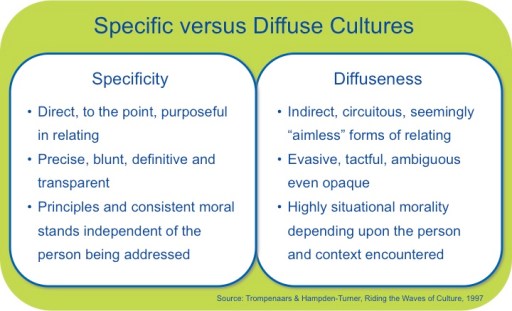
Now, why is it important to be aware of this cultural difference? Not because there is a good or bad side to it! Not because being direct is wrong and being indirect is by definition right. Not because being precise and transparent should always prevail over being cautious and evasive. Not because being open and blunt is always rude and insulting. Not because being silent is equal to being dishonest.
It is important to be sensitive to this cultural difference because it has a direct impact on the level of trust between each other! Because it can damage the relationship, and the collaboration! I vividly remember this discussion on a conference I attended not so long ago. At a certain moment during a panel discussion about cross-cultural relationships a British participant raised the question: “Do we not over-emphasize trust? Are we not making it too complex for ourselves?” A Chinese stood up and answered: “It depends on the quality of the relationship that you want.”
That is the essence: being direct or not, paying extra attention to the context or not, it all comes down to the quality of the relationship that you want. And this is not a one-way street. Sometimes being direct and assertive can be helpful, even be an example to others, and therefore strengthen the relationship. Sometimes a more listening and receptive attitude is what helps the relationship forward.
How can you improve the quality of cross-cultural relationships and avoid loss of Face in the teams you lead?
Be aware of low versus high-context cultural differences:
Pay extra attention to these differences. Observe carefully what happens during the meeting or conversation. Prepare yourself upfront, remember experiences from past meetings, talk with colleagues, and read about it.
Avoid ‘right versus wrong thinking’:
Focus on understanding what makes the behavior of the other different and why, not on what irritates you about it. Do not criticize, complain or condemn. Show respect for other opinions. Don’t say ‘you are wrong’. Say something like ‘I may be wrong. I frequently am. Let’s examine the facts.’
Adjust your communication style:
When ‘low-context’ meets ‘high-context’:
- Listen more than you speak
- Observe body language carefully
- Ask questions before you give an opinion
- Introduce your opinion in a way that adds value to the other
- Don’t force the other to give an opinion
- Show respect for hierarchy and age
- Pay attention to personal and family matters of the other
When ‘high-context’ meets ‘low-context’:
- Take what the other says at face value
- Speak up, be to the point
- Share your opinion when you have one
- Focus on tasks and facts
- Show your qualities and expertise to others
- Respect privacy
Use the difference in cultures as a strength:
Have an open mind and focus on how to reconcile the qualities of openness/transparency with those of patience/indirectness.
Written by Aad Boot and Hanneke Siebelink
If you want to receive upcoming LeadershipWatch articles and news in your mailbox, then simply register at the top of this page. Your personal information will be kept strictly confidential. Photo: jetheriot/Flickr (Creative Commons)Aad is a global leadership advisor, change leader, leadership team facilitator, executive coach, and frequently asked keynote speaker. He is founder and managing partner at HRS Business Transformation Services where he works with executives and leadership teams internationally on three key topics: ‘leading complex change’, ‘cross-cultural leadership’, and ‘post-merger integration’. Find out more about Aad and HRS’ services. If you would like to invite Aad to your organization feel free to contact him here.
Related articles
- Leadership: What is The Essence of Building Trust (leadershipwatch-aadboot.com)
- How Successful Cross-Cultural Leaders Work (leadershipwatch-aadboot.com)
Leading Change: Why Do Many Leaders Struggle to Create a Vision

In today’s business reality the level of complexity and the increased rate of change cause challenges for many leaders. Motivating people to change direction, building new strategies, transforming business models, and adopting new ways of collaboration. Quite a job! Especially in these times it is crucial for leaders to have a clear vision of the future. And this is not textbook talk. Walk around in organizations, look around and listen carefully to the people. They can quickly point out the leaders who have a vision versus those who have not. Successful organizations with motivated people will talk about their future and the vision they are accomplishing. Organizations in trouble will mention the lack of a vision as one of the key reasons for their stagnation or decline. In fact, in the course of history great leaders have always been praised for being visionary! However, many leaders struggle to create a vision. Is it because the ability to create a vision is only reserved for a small group of exceptional leaders? I don’t believe so. Envisioning the future is a universal quality that we all have. We just need to mobilize it and maintain it. And apparently this is not always easy. Why? What can leaders do to improve their capability to develop a vision?
By working intensively with business leaders over the past decades we have witnessed three specific obstacles that can hinder leaders to develop a vision of the future.
- Habituation
Habituation can grow when people are in the same situation for a period of time. It can even develop to such a level that we believe our situation is as good as it will ever get, and we stop believing that we can change it for the better. We can become complacent. We start to focus our energy on keeping what we have and perceive change as something bad that is trying to take this away from us.
How different this is from how this Chinese man perceived his situation:
Zhang Xin, a young man whose parents where wheat farmers in a poor agricultural province in central China, and who used to live with his family in a one-room house next to the fields. He had graduated from Tsinghua University (China’s MIT) and found himself a job as software engineer at Huawei in the city. His success, as Zhang once told a Time magazine reporter, had changed his family forever. None of his descendants would ‘ever work in the wheat fields again. Not my children. Not their children. That life is over.’ Zhang built a vision of a better life. Not only for himself but also for his family. He believed that a better future was possible and he started to chase it.
The belief that a better future is possible, not just for themselves but also for others, is a crucial driver for successful leaders to create a vision. They believe in a better future, even if no one else does.
- Impatience, wanting only quick success
I witness more than once how the hectic business environment of today drags leaders into a mindset of ‘go with the motions’. They are tempted to apply a short-term focus to keep up with the speed. After a while they even start to believe that this short-term focus is the only way to stay successful as a leader. They grow impatient and are only interested in actions that create quick results. They are even willing to lower the bar for themselves and others to be able to reach these short-term successes. At that point they are no longer aware of the fact that this lack of vision might jeopardize the future success of the company.
A powerful vision starts from within. Successful leaders take time to listen to their ‘inner voice’ on a regular basis. They schedule time to take a step back from the daily rush, to reflect about accomplishments, ambitions, aspirations, and about what they would like to change. They have learned over time to recognize the type of environment and setting that works best for them to do this. They look for circumstances to stimulate their brain with new experiences, to trigger their creativity. They have created this discipline because they know that these moments are essential for developing a clearer vision of the future. (Read this article ‘How Da Vinci-Like Thinking Helps You Imagine Future Success’)
- Letting go of the vision after experiencing setbacks
Some leaders do have a clear vision of the future, but have difficulty with dealing with the uncertainty that goes with it. They make detailed action plans with rigid and very specific expectations of the results that each step should bring. But as soon as they are confronted with disappointing results they lose confidence, start to doubt, and let go of their vision. These leaders forget that a vision is a strong desire, but without guarantees! It is a clear picture of the desired future, but very often without all the details. In fact, the journey towards it is often full of uncertainties.
Successful leaders understand the importance of an action plan to make the vision become stronger and clearer step by step, but they also know it requires willpower, flexibility, resilience and persistence along the way. (Watch this interesting speech about uncertainty and willpower by Jim Yong Kim – President at the World Bank)
.
“I believe life is a series of near misses. A lot of what we ascribe to luck is not luck at all. It’s seizing the day and accepting responsibility for your future. It’s seeing what other people don’t see. And pursuing that vision.” Howard Schultz, Businessman, Entrepreneur.
___________________
Aad is a global leadership advisor, change leader, senior leadership team facilitator, executive coach, and frequently asked keynote speaker. He is founder and managing partner at HRS Business Transformation Services where he works with executives and leadership teams internationally on three key topics: ‘leading complex change’, ‘cross-cultural leadership’, and ‘post-merger integration’. Find out more about Aad and HRS’ services. If you would like to invite Aad to your organization feel free to contact him here.
Related articles
- Leading Change: How Focus Creates Sustainable Change (leadershipwatch-aadboot.com)
Leading Change: How Focus Creates Sustainable Change

You hear and read about it everywhere: if you want to create successful and sustained change in your company, it is important to be focused and to transfer that focus to your people and teams. In the turbulence of the daily business reality where situations change rapidly, in which you are easily swamped by different and changing demands, objectives, and challenges, it is not easy to create focus. Leaders who are able to create and maintain a good and shared focus are far more successful than those who aren’t! But what is a good focus?
There is a lot of misinterpretation about what ‘being focused’ actually means:
Focus is not about accomplishing your tasks; it is about accomplishing your vision!
A few weeks back I was asked by a CEO to facilitate his executive team meeting. He explained to me what he believed was the main challenge for his organization: “We have been very successful the past decades as a company especially because we knew our strong points. Our whole way of working was aimed at maximizing our strong points without letting ourselves be distracted by other stuff. By doing this we created two kinds of people: the ‘managers’ who managed our products; and the ‘sales entrepreneurs’ who managed our customers. Now we are faced with a changing market, and we are not capable of responding quickly enough to these changes. Our managers and sales entrepreneurs are both screaming for more focus from the top. But they actually mean: ‘do not disturb us with your change initiatives and let us focus on what we’re good at: making our products and selling these to our customers’. Apparently they do not see that this kind of focus is no longer helping us forward at all. In fact, we need to change our focus, instead of sticking to what we always did. And for this we do not only need management and entrepreneurship, but also leadership. Not only in the top, but on all levels in the organization. Leaders who are able to create a shared focus on a new way forward; who are able to align their people around this new focus; who are people, team, collaboration oriented, as much as product, efficiency, customer oriented.”
The story of this CEO shows his interpretation of the required focus: the pressure to change and adapt demands a new focus. It demands a new focus based on looking forward, on knowing what we want to create together, on why this is important, and on the benefits we see. Focusing on the things we want to change, to create the company we want to become.
And yet, quite often when confronted with the need for change we see leaders proclaiming a focus, which is far removed from the focus described above. They describe a focus that is task oriented, short term oriented, focused on strengthening what we do today. Often a focus with a strong cost saving orientation, and less orientation on creating new value. A focus that is rather risk averse, not exploring possibilities for learning and growth.
In some business situations creating a focus aimed at ‘keeping and strengthening what we have got’ can be justified. However, most situations require leaders who create a different focus, one that aimes at creating successful and sustainable change.
Not easy! Most people seem to be able to live with a company focus that is keeping them inside known territory. If for instance we need to do more of the same in less time, raise the quality level of our product or service, or produce at lower cost; we seem to be able to deal with this. People will maybe not like the pressure that this company focus is putting on them, but they will go along with it. Up to the level that all energy and ideas are used and nothing is left. At that moment people reach the limit of what they believe is possible, feel numb and start acting unmotivated and uninspired. At that moment the company probably realizes that it needs to change more fundamentally, and that it will take a substantial amount of energy to do that. Energy that most people don’t have anymore at that moment!
Successful leaders create organizations that focus differently. In their organizations the focus is always aimed at the future, at how we see our desired future, at what we need to do differently to get there, at what we collectively gain when reaching it. At first they will encounter resistance and hesitation within the organization. Not so strange, because people are asked to get outside their comfort zones. The desired future is new and there is maybe uncertainty and a lack of confidence, so people will not easily follow. Nevertheless, successful leaders succeed in aligning their people around this focus. And by doing that they create energy instead of draining it! How do they do this? What specific traits do these leaders show? I observe the following recurring traits:
· Their focus is aimed at the longer term, not short term
They have a longer term focus based on their vision of their company’s desired future. They link the company focus to this desired future. They share their vision actively and discuss it openly with the organization. They do not lose energy in focusing on short-term temporary improvements; they focus on creating sustainable results.
· Their focus reveals a high level of personal alignment
They know their own qualities and weak points very well, as well as what they stand for. They act based on clear personal values and include these in their vision. Because of their high level of personal alignment, they explore different opinions with an open mind and feel no need to focus on themselves. Their focus is always on creating the best company results, in line with these key values. Read more about Personal Alignment here.
· Their focus arouses an eagerness among people
They pay special attention to the process of building a shared focus throughout the organization. For them focus is not just setting out tasks and actions. It is about creating a shared energy that drives us towards a common end result. They invite people to take part in defining the focus that is needed to create the desired future, and this builds motivation and commitment.
· Their focus is releasing smart energy
They are only interested in decisions and actions that will bring us closer to our destination. Even more, they are continuously challenging people to focus on the levers for change that will boost us forward, and not to focus on trivial things. They are allergic to ‘jumping to conclusions’ without knowing how it will bring us closer to our goal. But they are also allergic to procrastination and risk aversion when the way forward is to ‘experiment – learn – adjust’.
· They are persistent in their focus
They stick to the focus, even if results are not forthcoming at first sight. They show confidence and stay focused. This does not mean they will never change course, and will always rigidly keep following the initial plan. When they see that the vision will not be reached by maintaining the current focus, they are the first to shift focus. But as long as the focus is directing us towards the vision, they will keep this focus.
If you want to receive upcoming Leadershipwatch articles and news in your mailbox, then simply register at the top of this page. Your personal information will be kept strictly confidential. Photo: Giovanna Faustini/Flickr (Creative Commons)“The hardest thing when you think about focusing. You think focusing is about saying ‘Yes’. No. Focusing is about saying ‘No’.” – Steve Jobs
___________________
Aad is an international leadership advisor, change leader, senior leadership team facilitator, executive coach, and frequently asked keynote speaker. He is founder and managing partner at HRS Business Transformation Services where he works with executives and leadership teams internationally on three key topics: ‘leading complex change’, ‘cross-cultural leadership’, and ‘post-merger integration’. Find out more about Aad and HRS’ services. If you would like to invite Aad to your organization feel free to contact him here.
Related articles
- Leading Change: Why Do Many Leaders Struggle to Create a Vision (leadershipwatch-aadboot.com)
6 Contrarian Reasons Why You’re Lucky to Be a Leader Today
Our Guest Post on Switch & Shift:
 Nobody ever said that being a leader is simple. Certainly not in today’s world where changes seem to happen at the speed of light; where communication and collaboration are heavily impacted by new technologies; where management techniques from the past no longer appear to provide an adequate answer to the challenges of the future. Being a 21st century leader is a role not to be envied! Or is it?
Let’s look at it from a different angle. Today’s business reality offers leaders a number of interesting advantages. In fact, if people look to you for leadership today, you should consider yourself lucky. Why? Let me give you at least 6 reasons. Continue reading …
Leiding geven aan interculturele teams: Begrijp je de cultuurverschillen binnen jouw team?

This is a Dutch translation of a previously published Leadershipwatch article on how to deal with cross-cultural differences within your team. Click to read original article.
Voor leidinggevenden is het vermogen om mensen op één lijn te krijgen, om mensen te aligneren, een cruciale vaardigheid. Immers: mensen die echt gealigneerd zijn dragen gezamenlijke beslissingen alsof het hun eigen beslissingen zijn (in plaats van mee te bewegen omdat ze moeilijk anders kunnen); handelen vanuit overtuiging en toewijding (in plaats van mee te liften op de energie van anderen); en committeren zich persoonlijk tot het bereiken van de gewenste resultaten. Mensen aligneren was al belangrijk toen Henry Ford zijn automobielbedrijf van nul af uit de grond stampte, en wordt in de snel veranderende wereld van de toekomst nog belangrijker. Met de globalisering stijgt het aantal nationaliteiten en culturen waar je in je werkomgeving mee te maken krijgt. Hoe beïnvloedt dit gedragingen van mensen? Wat betekent dit voor het nemen en uitvoeren van beslissingen in teams? Hoe ga je hier als leider goed mee om?
Interculturele leiderschapskwaliteiten zijn in de 21e eeuw van cruciaal belang
Werken met interculturele teams, en de misverstanden waar je dan zoal tegenaan kunt lopen, was tot voor kort vooral een bron van sappige verhalen. Tegenwoordig echter beseffen steeds meer leidinggevenden dat culturele verschillen een bedrijf of organisatie voor serieuze uitdagingen kan plaatsen. Als zij er in slagen om culturele verschillen te overbruggen, waarbij mensen de voordelen van de culturele voorkeuren van elkaar leren begrijpen en combineren, kunnen zij het succes van hun bedrijf vergroten. Als zij hier niet in slagen, staat de deur wagenwijd open voor miscommunicatie, tegenwerking, en conflicten, die succesvolle groei en innovatie serieus in de weg kunnen staan.
Daar komt nog een bedenking bovenop. De buitenlandse investeringsstroom was de afgelopen jaren grotendeels eenrichtingsverkeer: westerse bedrijven richtten hun blik op het oosten, en openden dochterondernemingen of joint ventures in China en andere Aziatische tijgerlanden. Westerse culturele invloeden en denkpatronen verspreidden zich in het oosten. Chinezen volgden westerse leiderschap programma’s, haalden hun diploma’s in Amerikaanse en Europese business schools, en maakten kennis met westerse managementprincipes. In de toekomst echter kunnen we meer fusies en overnames van Oost naar West verwachten, zoals Chinese bedrijven als Huawei Technologies, Lenovo en Geely nu al laten zien. Voor de nieuwe generatie leiders, of ze nu opgroeiden in het Oosten of het Westen, wordt het leren overbruggen van cultuurverschillen dus nog een stuk belangrijker.
Als ik leiderschap teams begeleid bij het omgaan met de uitdagingen van intercultureel samenwerken, grijp ik dikwijls terug naar wat ik in het verleden heb geleerd van Fons Trompenaars en Charles Hampden-Turner. Ik heb het geluk gehad met hen samen te werken en aan den lijve te ondervinden hoe je bedrijfsresultaten meetbaar kunt verbeteren door cultuurverschillen binnen management teams te overbruggen en echte alignment te creëren tussen mensen.
Ik leerde drie cruciale lessen, die vandaag relevanter zijn dan ooit:
1) Alles begint met het creëren van een wederzijds bewustzijn van de cultuurverschillen die succesvol samenwerken hinderen.
Succesvolle leiders zijn niet bang om een discussie uit te lokken over de cultuurverschillen die zij in hun teams denken te zien, en over de impact van deze verschillen op prestaties en gedrag. Zij vinden zo’n discussie nodig. Ze begrijpen dat het creëren van een open gesprek cruciaal is om onderling vertrouwen en respect te creëren.
2) Culturele verschillen kun je enkel overbruggen als je begrijpt waar ze vandaan komen.
Ik ontmoet vaak leidinggevende teams waar de discussie zich beperkt tot het uitwisselen van standpunten, en het overeenkomen van acties om de negatieve gevolgen van de gepercipieerde verschillen te beperken. Succesvolle leiders begrijpen dat dit niet volstaat om de situatie blijvend te verbeteren. Zij willen verder gaan dan enkel zien waar de culturele hinderpalen zitten. Zij willen begrijpen waar deze verschillen vandaan komen, ervan leren, en zij willen dat hun teams ook echt begrijpen en leren. Zij weten dat het in dergelijke discussies nooit draait om ‘juist’ versus ‘verkeerd’, maar altijd om ‘percepties’ en ‘waarden’ die er achter verschillende percepties schuilen. Zij begrijpen dat het van iedereen extra inspanning en openheid zal vragen om tot dit niveau te komen, maar zijn ervan overtuigd dat dit de sleutel is om mensen in het team daadwerkelijk nader tot elkaar te brengen.
3) Interculturele verschillen overbruggen vraagt een oplossing waarbij culturele waarden elkaar versterken, niet een klassiek compromis.
Succesvolle leiders zien in culturele verschillen een opportuniteit om het beste van beide werelden met elkaar te verenigen. Dit betekent nieuwe manieren creëren om te kijken naar en om te gaan met de verschillen in onze cultureel bepaalde voorkeuren. Niet elkaar bekampen, maar juist onze krachten combineren. Zij vermijden compromissen; deze leiden meestal enkel tot tijdelijke en middelmatige uitkomsten. Zij zoeken naar oplossingen waarbij beide culturele waarden elkaar versterken en bereiken zo de beste resultaten.
‘Als we beide water in onze wijn doen, eindigen we beide met slechte wijn. Maar als we de kwaliteit van onze beste druiven combineren, creëren we misschien een fantastische nieuwe wijn.’
Deze video kreeg ik van iemand die dagelijks tegen interculturele verschillen aanloopt: een krachtig betoog door Devdutt Pattanaik. Wat aan de lange kant misschien, maar ik ben ervan overtuigd dat je het net als ik de moeite waard zult vinden.

Welke interculturele verschillen neem jij waar in jouw team? Hoe beïnvloeden deze verschillen de team prestaties? Hoe ga jij om met deze cultuurverschillen? Hoe creëer jij een sterker gealigneerd team? Ik kijk uit naar je reacties!
————————————————————
Aad is een internationaal organisatieadviseur, verandermanager, alignment expert, leiderschapsteam begeleider en executive coach. Hij is oprichter en managing partner van HRS Business Transformation Services en werkt internationaal met senior leiders en leiderschapsteams op drie kerngebieden: ‘leidinggeven aan complexe veranderingen’, ‘intercultureel leidershap’ en ‘post-acquisitie integratie’. Vind hier meer over Aad en HRS services. Contacteer Aad voor meer informatie.
Sustainable Change: Know How to Handle Complexity Across Cultures

Business leaders of today face a high level of complexity. Globalization, technological evolutions, market shifts, an increased pace of change. These have changed the business landscape. Business environments are more cross-cultural now than ever before. Cultural differences are changing working relationships and are impacting business success. How do 21st century leaders deal with this complexity in a sustainable way? How do they align cultural differences when dealing with complexity? Let’s pick out one important element!
Cultural differences in how we manage time can hinder us in handling complexity
The valuation of time is different in various cultures, and this is often overlooked.
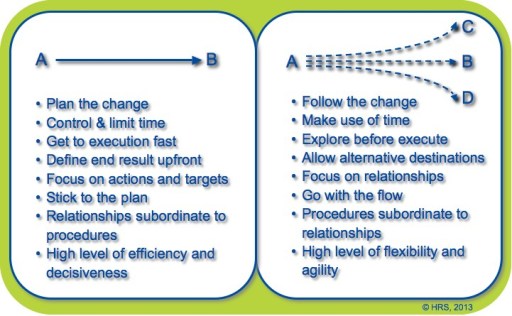
I vividly remember the discussions in this leadership team, which was putting together a strategic plan in response to the changes in the marketplace. The team was a mix of American, European, and Asian executives. The debates were very difficult and they had a hard time coming to results. The core reason for this was a different perception on how to manage complexity, caused by a different valuation of time. The difference boiled down to the following: one part (let’s call it the Western part) of the team saw complexity as something you want to control. They focused on planning and control techniques. In their minds time was seizable, controllable, measurable. They used words like ‘time is money’, and ‘we are running late’. In their thinking it was all about analyzing current and desired situation, and about getting from A to B in the shortest time. They believed the situation should be tackled by focusing on efficiency and control, process and procedures. Complexity had a rather negative connotation: you want to stop it or limit it.
The other part (let’s call it the Eastern part) of the team had a totally different valuation of time. For them time was not linear, but rather cyclic. Not something you want to control to get things done, but something that allows you to explore and learn. For them the change was not predefined, from A to B. On the contrary, they did not want to make prefixed choices, but wanted to take time to explore. More like following the flow to see what it can bring. For them the focus was not on plans, actions and targets, but on relationships. For them time was a means to develop and cultivate closer relationships, like a seed planted to grow. Good relationships would allow them to deal with whatever complex change they would encounter. In fact, their whole perception of complexity was different. Complexity had a more positive connotation: it offers new chances and possibilities. (Did you know that in the Chinese language words like ‘valuable’, ‘promising’, ‘potential’, and ‘deep’ are synonyms for complexity?)
For a nice read about how our perception of time affects doing business in China I recommend this article of Justin Shuttleworth.
The difference in time valuation, which Fons Trompenaars & Charles Hampden-Turner describe in their book ‘Riding the waves of culture’ as ‘sequential’ versus ‘synchronic’ time orientation, hindered the team significantly. ‘The West’ had the feeling that ‘The East’ was not efficient, not decisive, not structured enough to come to a good strategic plan. ‘The East’ had the feeling that ‘The West’ was careless, single-minded and pushy, not patient enough to come to a good strategic plan. The executive team was experiencing difficulty in finding an effective way to deal with the complex change, and therefore, so was the organization.
The difference between sequential and synchronic orientated cultures can be experienced when Western and Eastern cultures meet each other. But be aware not to generalize too easily and make it a caricature between East and West. Within the East and the West you’ll find nuances. For instance, in Europe you can find cultural differences between northern and southern cultures, which are comparable.
How successful leaders deal with cultural differences in time orientation
The more organizations are confronted with cross-cultural collaboration (internally and externally), the more they will experience this difference in time orientation. And this will affect the way people respond to complexity and change. Successful leaders are aware of this and pay special attention to aligning these different cultural orientations.
- Are you paying attention to signals that reveal differences in time orientation?
- Do you make others aware of these different orientations?
- Do you stimulate people to share their way of looking at the complex change they face?
- Are you enabling people to better understand each other’s orientation?
- Do you understand the strengths of both orientations?
- Are your people aware of these strengths?
- How do you encourage people to combine these strengths?
- How does your team combine efficiency and speed with exploring new, different and stronger relationships?
___________________
Aad is an international business advisor, change leader, senior leadership team facilitator, and executive coach. He is founder and managing partner at HRS Business Transformation Services where he works with senior executives and leadership teams internationally on three key topics: ‘leading complex change’, ‘cross-cultural leadership’, and ‘post-merger integration’. Find out more about Aad, our team, and HRS’ services. If you would like to invite Aad to your organization feel free to contact us here.
Related articles
- Creating Team Alignment: Team Development Initiatives Should Fit Today’s Business Reality (leadershipwatch-aadboot.com)
- The People Alignment Compass – Part 3 (leadershipwatch-aadboot.com)
- Leadership: What is The Essence of Building Trust (leadershipwatch-aadboot.com)
Creating Team Alignment: Team Development Initiatives Should Fit Today’s Business Reality

One of the things our work with multinational companies has taught us is the growing importance of cross-team collaboration. For 21st century businesses it has become a vital prerequisite for building success. And this has an impact on the team development initiatives you undertake.
We see two major evolutions taking place in today’s business reality, which affect team collaboration:
- Mergers & acquisitions, alliances, and other new emerging forms of collaboration between organizations involve much more cross-border and cross-cultural aspects than before.
Management and employees are in many cases not used to deal with these new circumstances. Cross-cultural challenges increase the degree of complexity of successful collaboration. When results are not met, when motivation is going down, when irritation and emotions flare up, and we take a closer look at what is going on, it almost always comes down to the fact that there is not enough people alignment within and between teams to cope effectively with the cross-cultural and cross-border challenges they face. And this turns out to be a crucial obstacle, which prevents the organization to be successful.
- Business environments are changing faster than before, and therefore businesses need to manage change differently.
Long term planning and fixed predetermined steps are no longer the key to success. It has become crucially important to be able to navigate and adjust course during the journey. Leaders need to develop cultures in which adaptability, agility, and resilience are key qualities. And these do not develop automatically. They require a company-wide ability of people and teams to continuously create alignment with each other to find and implement the right response to the changes taking place around them.
Both trends demonstrate the importance of having aligned teams that are able to collaborate successfully in these new circumstances. Our experience is that team development has shifted from “a rather soft aspect of business, which we address when we have the time” to “one of the essential hard success factors that make or break our organization”. And this means that we need to revisit the way we approach team development. We see the following points of attention:
- Building team alignment requires a strong focus on the challenges and issues your business is facing. In other words, team development initiatives have no sustainable effect when they do not support the team to transform its real life business challenges into concrete team actions that have clear and positive results in the field.
- Team alignment is a process. It requires a sustained effort of ‘learning by doing’, in which there is an incremental deepening of the level of alignment and a recurring follow up on results. A good mixture is needed between off site (reflection, deepening) and on site (real life monitoring, coaching, doing) activities.

Click to Download Brochure
Is your company struggling with cross-team collaboration? Do you experience a lack of team alignment? In that case our Team Alignment Program might interest you. It combines two+ decades of experience in working with teams internationally, especially also teams facing the evolutions described above.
___________________
Aad is an international business advisor, alignment expert, leadership team facilitator and executive coach. As founder and managing partner at HRS Business Transformation Services he works with executives and leadership teams internationally on three key topics: ‘leading complex change’, ‘cross-cultural leadership’, and ‘post-merger integration’. Find out more about Aad and HRS’ services. If you would like to invite Aad to your organization feel free to contact us here.
Related articles
- Sustainable Change: Know How to Handle Complexity Across Cultures (leadershipwatch-aadboot.com)
- The People Alignment Compass – Part 3 (leadershipwatch-aadboot.com)
- Cross-Cultural Leadership: How to Avoid Making People Lose Face (leadershipwatch-aadboot.com)
- Leadership: What is The Essence of Building Trust (leadershipwatch-aadboot.com)
- Cross-Cultural Leadership: Jacques Rogge on Negotiating with the Chinese (leadershipwatch-aadboot.com)
Verandermanagement: Waarom het aligneren van mensen cruciaal is voor zij die veranderingen leiden

This is a Dutch translation of a previously published Leadershipwatch article on the importance of people alignment, especially for those who lead change. Click to read original article.
‘We hadden een duidelijke strategie uitgezet, maar ik zie nog steeds geen concrete resultaten.’‘Hoe vaak moet ik mijn mensen er nog van overtuigen dat deze verandering belangrijk is voor ons? Ze zeggen dat ze het begrijpen, maar na verloop van tijd grijpt iedereen terug zijn oude gedrag, alsof ik nooit iets heb gezegd.’
‘Iedereen zal je vertellen dat we weten waar we de komende vijf jaar naartoe bewegen, omdat we samen onze toekomstvisie hebben uitgetekend. Maar als je de mensen in ons team apart zou vragen wat deze visie precies betekent voor ons bedrijf, krijg je vijftien compleet verschillende verhalen.’
‘We hadden de afgelopen tijd veel meer kunnen bereiken als iedereen de schouders onder deze beslissingen had gezet. We verliezen terrein omdat sommigen zich niet betrokken voelen en de urgentie niet inzien. Ze doen wat hen gevraagd wordt, maar zijn niet echt gecommitteerd.’
Komen deze uitspraken je bekend voor? Het is een slechts een greep uit de uitspraken en situaties waar ik in mijn dagelijkse werk als begeleider van complexe veranderingstrajecten mee word geconfronteerd. Al deze situaties hebben het volgende met elkaar gemeen: mensen dachten dat ze op één lijn zaten – als team gealigneerd (aligned) waren om het met een Engels woord te zeggen – maar waren dat in feite niet. Een onderschatte situatie. In elk van deze praktijkgevallen bleek het niet echt gealigneerd zijn van de mensen een veel ernstiger obstakel te zijn voor het bereiken van de gewenste resultaten, dan over het algemeen werd vermoed.
We ondervinden het allemaal: de wereld om ons heen is in rap tempo aan het veranderen. En ik trap een open deur in als ik stel dat effectieve samenwerking cruciaal is om succesvol met deze veranderingen om te kunnen gaan, om als bedrijf innovatief te blijven en de gewenste toekomst vorm te geven.
Hoe kan het dan dat bovenstaande organisaties, die toch stuk voor stuk veel energie, tijd en middelen besteedden aan het begeleiden en motiveren van hun werknemers, moesten constateren dat hun inspanningen niet resulteerden in het gewenste enthousiasme, in succesvol teamwerk, en in de gewenste resultaten?
De lijst met mogelijke verklaringen verschilt van organisatie tot organisatie, omdat de karakters van de mensen die er werken, de specifiek uitdagingen en de aard van de veranderingstrajecten van elkaar verschillen. Toch hebben ruim twintig jaar ervaring mij geleerd dat de volgende oorzaken veelal een hardnekkige en cruciale rol spelen:
- De neiging om ons te verliezen in actiegerichtheid. Opgejaagd door de drukte om ons heen zijn we vaak ongeduldig en hebben we de neiging om beslissingen te nemen zonder het onderliggende probleem goed genoeg te begrijpen. We beginnen onmiddellijk aan oplossingen en uitvoering te denken, terwijl het probleem vaak wordt veroorzaakt door het feit dat betrokken collega’s gewoonweg onvoldoende met elkaar gealigneerd zijn – vaak zonder het zelf echt te beseffen;
- Geloven dat investeren in menselijke relaties iets is wat we ook wel later kunnen doen, als er meer tijd voor is. Voor bedrijven en organisaties is de druk om te presteren en bij te blijven onveranderlijk groot, wat ervoor zorgt dat mensen in de regel allergisch zijn voor tijdverlies. We hebben instinctief de neiging om de nadruk te leggen op de ‘harde’ kant van veranderingen (structuren, procedures, systemen, etc) omdat we denken dat die het snelst meetbare resultaten opleveren. De moeilijkere ‘zachte’ mensenkant wordt uitgesteld tot later. Maar het is juist deze ‘zachte’ mensenkant die de meeste ‘harde’ en blijvende bedrijfsresultaten op kan leveren;
- Onderschatten wat er precies voor nodig is om mensen echt te aligneren. Echt krachtige samenwerking tussen mensen ontstaat pas als er sprake is van wederzijds respect, openheid en vertrouwen. Leiders die deze elementen hoog in het vaandel dragen, en werken aan openheid, respect en vertrouwen binnen hun teams, kunnen bergen verzetten. Als openheid en vertrouwen ontbreken doen er zich soms onaangename verrassingen voor. In de voorbeelden hierboven werd er gecommuniceerd en geluisterd. Mensen knikten ‘ja’ maar waren niet echt gecommitteerd. Op de een of andere manier beweerden ze dat ze begrepen wat er van hen gevraagd werd en dat ze het er ook mee eens waren, maar diep vanbinnen voelden ze zichzelf niet echt betrokken. Op de een of andere manier namen ze deel aan de discussie, maar voelden ze zich niet veilig genoeg om hun bedenkingen openlijk te delen met de anderen.
Als mensen echt gealigneerd zijn dragen zij gezamenlijk genomen beslissingen alsof het hun eigen beslissing is (in plaats van mee te bewegen omdat het moeilijk anders kan), handelen zij vanuit overtuiging en toewijding (in plaats van mee te liften op de energie van anderen), en committeren zij zich persoonlijk tot het bereiken van de gewenste resultaten.
Succesvolle leiders hebben het vermogen om mensen te aligneren, juist in complexe en snel veranderende omgevingen. Ze besteden bewust veel aandacht en energie aan het uitbouwen van alignment en zien dit als essentieel onderdeel van hun rol als leider. Zij beseffen dat het essentieel is om het succes van hun organisatie duurzaam uit te kunnen bouwen.
Hoe bouw jij alignment? Ik ben benieuwd naar je ervaringen, opmerkingen of vragen.
Als je nieuwe Leadershipwatch artikelen direct in je mailbox wilt ontvangen, aarzel dan niet en schrijf je in bovenaan deze pagina. Je persoonlijke gegevens zullen strikt vertrouwelijk blijven.————————————————————
Aad is een internationaal organisatieadviseur, change leader, alignment expert, leiderschapsteam begeleider en executive coach. Hij is oprichter en managing partner van HRS Business Transformation Services en ondersteunt internationaal leiders en leiderschapsteams op vier gebieden: ‘leidinggeven aan complexe veranderingen’, ‘intercultureel leidershap’, ‘post-merger integratie’, en ‘versterken van business performance’. Vind hier meer over Aad en over onze HRS diensten. Of contacteer Aad voor een vrijblijvend gesprek.
Organizational Alignment: The Power of Cross-Organizational Networks

How do organizations deal with the changes in today’s business environment? How do they keep up with the pace of change, let alone get ahead of it? How do they innovate and stay competitive? How do they increase their adaptability? How do they create organizational alignment quickly enough? Do they hang on to hierarchical structures as the main drivers for change? Or do they explore and stimulate cross-organizational networks as a new way to enable people and teams to collaborate more effectively across borders?
I witness a tenacious tendency within many organizations: the more things change around us, the more we tend to hold on to what is familiar to us. We tend to focus more on hierarchical structures and managerial processes. It gives us a feeling of control and overview. But, in fact, it is limiting collaboration, flexibility and adaptability. Many organizations struggle with this phenomenon.
“WHEN BUSINESS WAS FINE WE DIDN’T HEAR ANYBODY ABOUT IT. BUT NOW THE MARKET IS CHANGING EVERYBODY COMPLAINS ABOUT HOW INTERNAL SILOS ARE HINDERING US AND HOW THEY SEEM TO GROW STRONGER.”
Leaders need to stimulate exactly the opposite of what is often the organization’s reflex. Encourage people to collaborate more across borders instead of less. Leaders need to stimulate the creation of cross-border networks that combine the best knowledge, skills, experience, attitude available across the organization, needed to get a certain job done.
To be clear, in itself this is not new. Cross-unit and cross-team collaboration have always been important for a company’s success. But in the 21st century business reality there are two main reasons why cross-organizational collaboration has become more crucial than ever before:
- The accelerated rate of change: organizations need to be able to adapt quicker in a more agile way
- The changing relationships between companies and their customers, suppliers, and competitors: traditional boundaries are diminishing, and this calls for new ways of cross-border collaboration
I am not saying that hierarchical structures and managerial processes are no longer needed, but they will no longer be enough to deal with today’s challenges. Leaders need to put focus on creating and stimulating cross-organizational networking as an additional structure for collaboration. A new way of collaboration that leads to higher adaptability, agility, and responsiveness with respect to the new circumstances.
“Traditional hierarchies and processes, which together form an organization’s “operating system”, do a great job of handling the operational needs of most companies, but they are too rigid to adjust to the quick shifts in today’s marketplace. The most agile, innovative companies add a second operating system, built on a fluid, network like structure, to continually formulate and implement strategy.” – John Kotter, Harvard Business Review, Accelerate, 2012 (read the article)
Yet, many organizations do not have cross-organizational networks or leaders are not aware of these networks and don’t use them.
“While common sense might suggest that cross-departmental support for innovation would be a good thing, getting everyone involved is not a widespread practice. Survey respondents said they typically ask only certain departments for ideas, while other departments are relegated to implementation.” – Economist Intelligence Unit, Cultivating Business-led Innovation, 2012 (download the research report)
I have witnessed with my own eyes how cross-organizational networks can have a positive impact on collaboration and how they can boost a company’s success. One of the examples is a client we work with who has faced fundamental changes in the market. Growing competition from the east; increasingly demanding customers; technological advancements that require longer, more complex, and more expensive research and development cycles; alliances with suppliers to create pools of joint innovation, research and knowledge sharing. The board has chosen early in the process to fundamentally change the way divisions, units and teams needed to collaborate. Existing structures are not thrown overboard but are supplemented with cross-organizational networks. Key objectives are on the one hand to speed up the research & development process and on the other hand to create more alignment between the departments and teams of engineering, sales, and customer service. Networks can have a different focus: streamline knowledge sharing, tackle specific cross-border issues, act as sounding board to provide a second opinion, etc. Networks don’t stop at the company borders but can also include customers and suppliers. Some networks have become institutionalized; others are contemporary and will dissolve over time.
Together with the top 30 executives of the company we shared and discussed the progress they made over the past year. They reported the following results:
- A higher level of innovative thinking
- Better and faster decision making
- Better use of knowledge, expertise, experience, ideas
- Stronger basis for successful implementation/execution
- Better detection and development of key talent
- Motivating environment for employees to learn and grow
How did they do it? How did this team of executives create the new way of cross-organizational collaboration? Three aspects in their leadership behavior stick out:
Stimulate networks actively and openly:
- Analyze existing networks. Every organization has its hidden and informal networks. Make sure you understand where they are, who is in it, how they operate, and what their outcome is. Focus on stimulating and supporting the networks that add value. Stop or replace the networks that are not.
- Make networks a ‘formal’ part of your organization. Make them visible to everyone. Explain their importance and encourage them. At the same time discourage silo behavior.
- Focus your energy on communicating vision and strategic priorities and less on managing processes. Focus on the results and set the strategic boundaries. Allow the networks to fill in the rest of the strategy and to come up with ways to manage the results.
- Stimulate diversity within the networks. Make sure they combine people from different teams, cultures, expertise, and locations.
“The most effective networks connect to people with diverse expertise, from a broad range of functions, and across different locations.” – MIT Sloan Management Review, The collaborative organization: How to make employee networks really work, 2010 (read the article)
Make your people’s ability to create cross-border alignment a top priority:
- Invest time and energy in supporting leaders, employees and teams to learn how to create people alignment across borders and cultures. Define it as a core competency for everybody. Set up development and coaching programs to build the required mindset and skills.
- Create an alignment culture throughout the organization. Make the importance of people alignment explicit in your communication, in your strategy, in your behavior, and in your reward system.
- Stimulate a learning environment where people can build successes together. Register these successes. Share, communicate and celebrate them actively throughout the organization.
“Being a successful network requires more than having the right knowledge around the table. If the people are not able to align their different areas of expertise, experiences, objectives, cultures, they will be useless as a network.” – cross-divisional network member
Change the mindset of people about failure:
- Start at the top. Understand that cross-organizational networks need a certain level of space, if you want them to become successful. Make sure the strategic priorities are clear, but allow networks to fill it in and experiment. Let go of the urge to control every part of the process.
- Give networks space to make mistakes and to learn from it. This can be in contradiction with what people are used to. There can be a fear of failure within the organization that can hinder this new way of collaboration. Be explicit to your people that mistakes are not failures, as long as they allows us to learn and grow individually and collectively (also read my earlier article on this).
“One who fears the future, who fears failure, limits his activities. Failure is only the opportunity more intelligently to begin again. There is no disgrace in honest failure; there is disgrace in fearing to fail.” – Henry Ford, My Life and Work, p. 47
What do you think of cross-organizational networks? What are your experiences with networks? What are your questions? Share your comments below.
If you want to receive upcoming Leadershipwatch articles and news in your mailbox, don’t hesitate and register at the top of this page. Your personal information will be kept strictly confidential. Photo: WebWizzard/Flickr (Creative Commons)___________________
Aad is an international business advisor, change leader, people alignment expert, leadership team facilitator and executive coach. He is founder and managing partner at HRS Business Transformation Services where he works with executives and leadership teams internationally on four topics: ‘leading complex change’, ‘cross-cultural leadership’, ‘post-merger integration’, and ‘amplifying business performance’. Find out more about Aad and HRS’ services. If you would like to invite Aad to your organization or team feel free to contact Aad here.
 LeadershipWatch